
PIPA BOY: SCENES FROM THE POST-DIASPORA
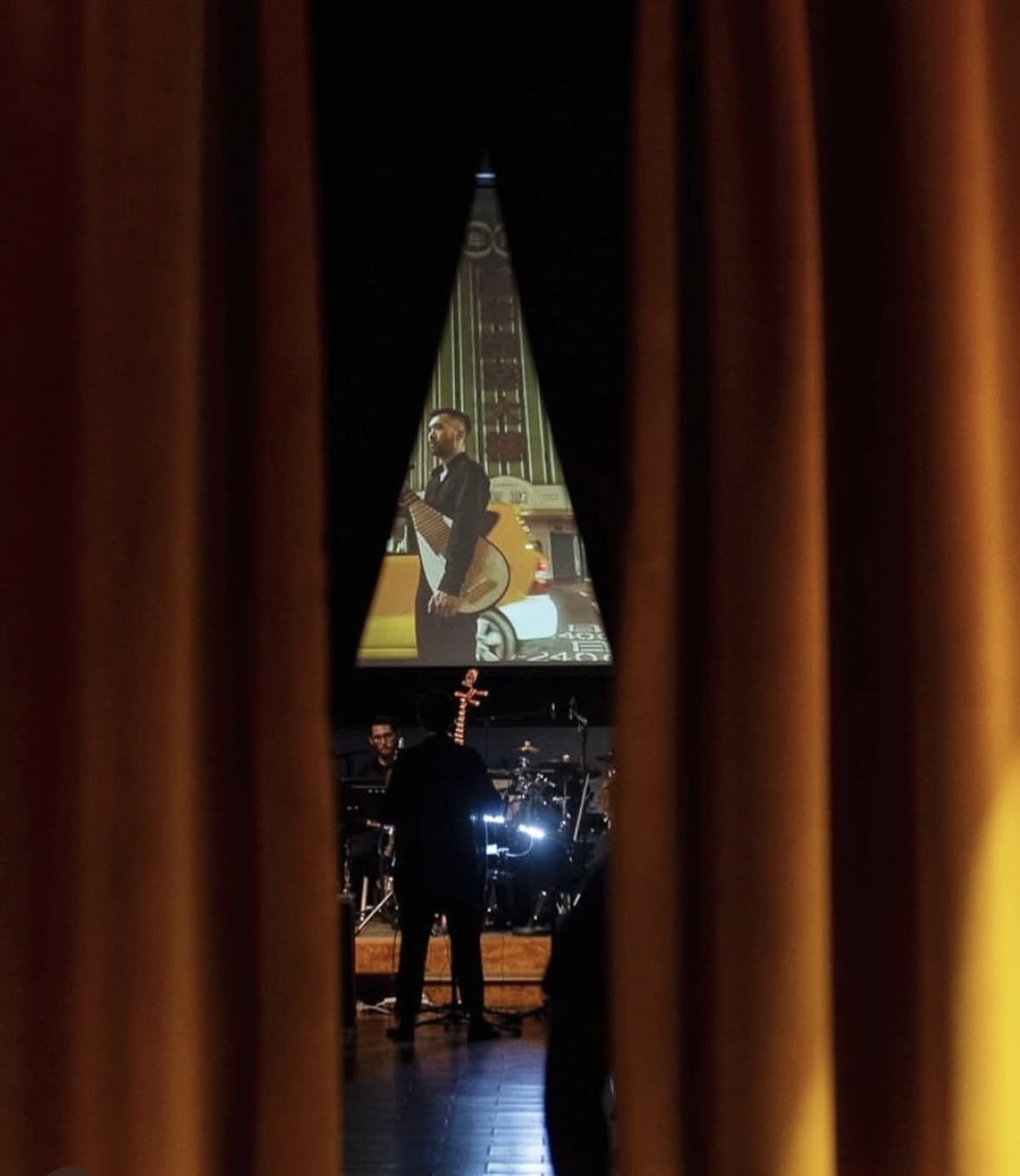
As part of our 2025-2026 season, the BlackBox Ensemble will present a multidisciplinary program around the U.S. premiere of Baldwin Giang’s PIPA BOY, a 20-minute work for ensemble, pipa, and video installation. Cast in three movements, the piece presents portraits of three places – Taipei, Rome, and his home city of Philadelphia – that are central to Baldwin’s personal and family history. The piece blends live performance with immersive video, filmed with local filmmakers in each of the three cities. PIPA BOY features internationally renowned pipa soloist Yang Jin, known for her expressive artistry and versatility across traditional, contemporary, and cross-disciplinary settings.
In this interview, Leonard spoke with Baldwin about how the piece came to be, the ideas it explores, and the cross-continental story it tells. They also discussed how the film component relates to the music, how Baldwin and his collaborators chose their filming sites, and how the process of filming and composing overlap.
BALDWIN GIANG in conversation with LEONARD BOPP
WEDNESDAY NOV. 26, 2025
LB: Can you tell us about the history of the piece, how it came to be?
BG: I wrote the piece on and off over two years. The idea for the piece began when I was doing a Fulbright Artist Fellowship in Taiwan. My project was to learn how to play the pipa, and I studied at Taipei National University of the Arts with the wonderful teacher Yun-han Su. Over the course of the year, I developed this idea to write a piece for pipa, ensemble and video. One of the earliest inspirations was thinking about how the pipa is a product of human migration. It came from the Middle East — it’s related to the Middle Eastern oud — it came to China two thousand years ago, and has since spread throughout Vietnam, Japan, and Korea, which have their own versions of the instrument. Maybe all cultural objects are actually products of human migration, but I felt like the pipa was a really vivid example. And it’s also a very living practice. My exposure to the pipa before going to Taiwan was really just what I could see in the United States, which was that it was used to play traditional Chinese music. And going to Taiwan, I realized that it’s actually part of this modern, thriving musical landscape. So I wanted to write a piece that put the pipa into a forward-looking, future-oriented dialogue.
And then I moved to Rome for a year, and I took the pipa with me. And I got really interested in the Chinese community in Rome, which, for most of the 20th century, was the largest ethnic minority in Italy. So there’s a long history of Chinese immigrants coming to Italy and forming their own communities. I wanted to explore that, but also think about how migrant communities in Rome intersect with queer communities. And a large part of this was just my own embodied research — these were the communities that I was most in touch with, and I saw lots of ways in which they overlapped.
So I came to realize that while this was about the pipa in these different places and cultures, it’s also a kind of self-portrait. So then I added a place that’s very important to me, my hometown of Philadelphia. And I thought a lot about my cultural experiences in Philadelphia, and particularly the long history of historical efforts to marginalize Chinatown. This also led to the addition of the film component, where I appear in the video, holding the pipa, going through places where I have lived.
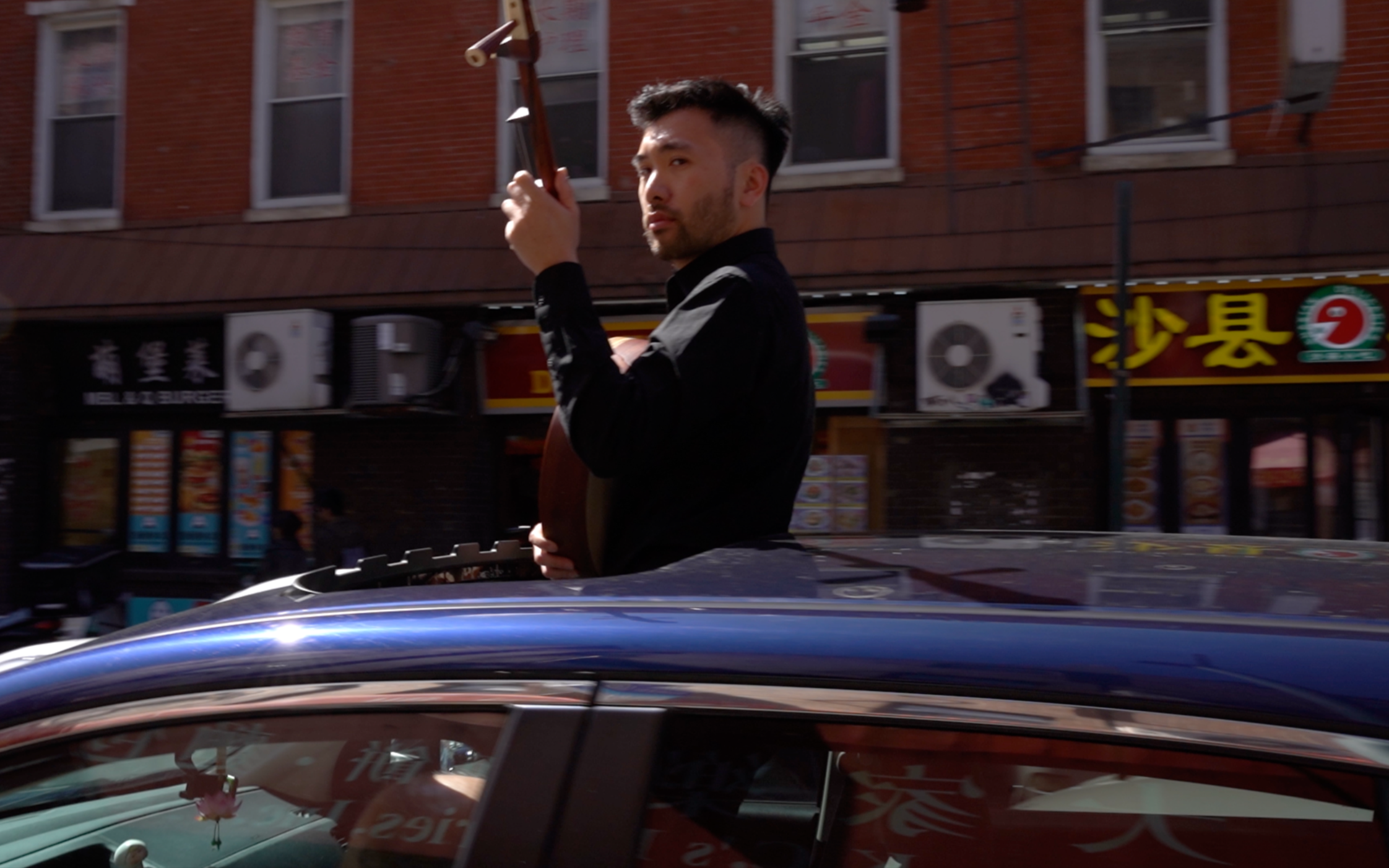
I had to live in these places for a minimum of ten months to really find the locations that meant something to me and that I thought would mean something to an audience. I also included the film because it allowed me to engage with these communities and places in a way that just writing a piece of music wouldn’t. I filmed the videos before I wrote any music. There were hours and hours of footage from each of these locations. I wrote music in response to these segments of film, but I also let myself be free about the music I wanted to write. Only after I finished the music did I edit the videos to fit the music, sometimes in collaboration with the filmmakers.
LB: How did you choose the filmmakers that you wanted to work with, and what was the process of filming and shooting?
BG: I got to know people engaged in the arts in each city, and then just started asking them if they had any friends who were filmmakers. I interviewed a bunch of filmmakers, and eventually collaborated with three people who were really amazing to work with: Brian Erickson in Philadelphia, Chris Kang in Taipei, and Andrea Bancone in Rome.
Then, I picked places where I thought that identity needed to be renegotiated given the globalized public that passes through them. The first place I picked was XiMenDing,, the busy tourist shopping district in Taipei. As an East Asian person in the United States, one of the things you kind of realize is that people in the US have a comparatively limited perspective, or imagination, about where you’re from. But when you go to a place that’s as globalized as XiMenDing, and even other parts of Taipei, suddenly people are much more imaginative about where you could be from — you could talk to restaurant owners and they’ll ask you where you’re from, and they’ll guess Malaysia, Vietnam, Korea, wherever. It wasn’t always comfortable, but it felt actually like a generative kind of imagination, in a way that didn’t feel as orientalizing or exoticizing as in the west sometimes. And it made me imagine there could be a time when nobody has any idea where you’re from, that no one could make assumptions based on how you look, and instead, anybody could be treated as a local. I picked locations like this in all three cities.
LB: That’s interesting that you bring up time of day, too. It seems like you’re interested in spaces of transience or liminality, whether that’s time of day or urban geography, and how that reflects, but also reconstitutes, the people who are interacting with those spaces at those given times.
BG: Yes, you know, I think that our identity is formed in part by our interactions with our environment. I think that’s a basic axiom of this piece. The other thing, to get to your question about how this is represented sonically, is that in the same way these spaces are renegotiated, the music is constantly recontextualizing harmony. Much of the harmony is microtonal, and you hear different perspectives on the same harmony through slight microtonal alterations. It’s kind of like walking around a sculpture and seeing it from different angles. The piece is very melodic, too, and I think something similar happens with line — sometimes it sounds like it could be in a pop piece, and then other times you have the same materials slightly tweaked, and it sounds like much more of an experimental practice.
LB: What is the function of the film, and how does it relate to the music?
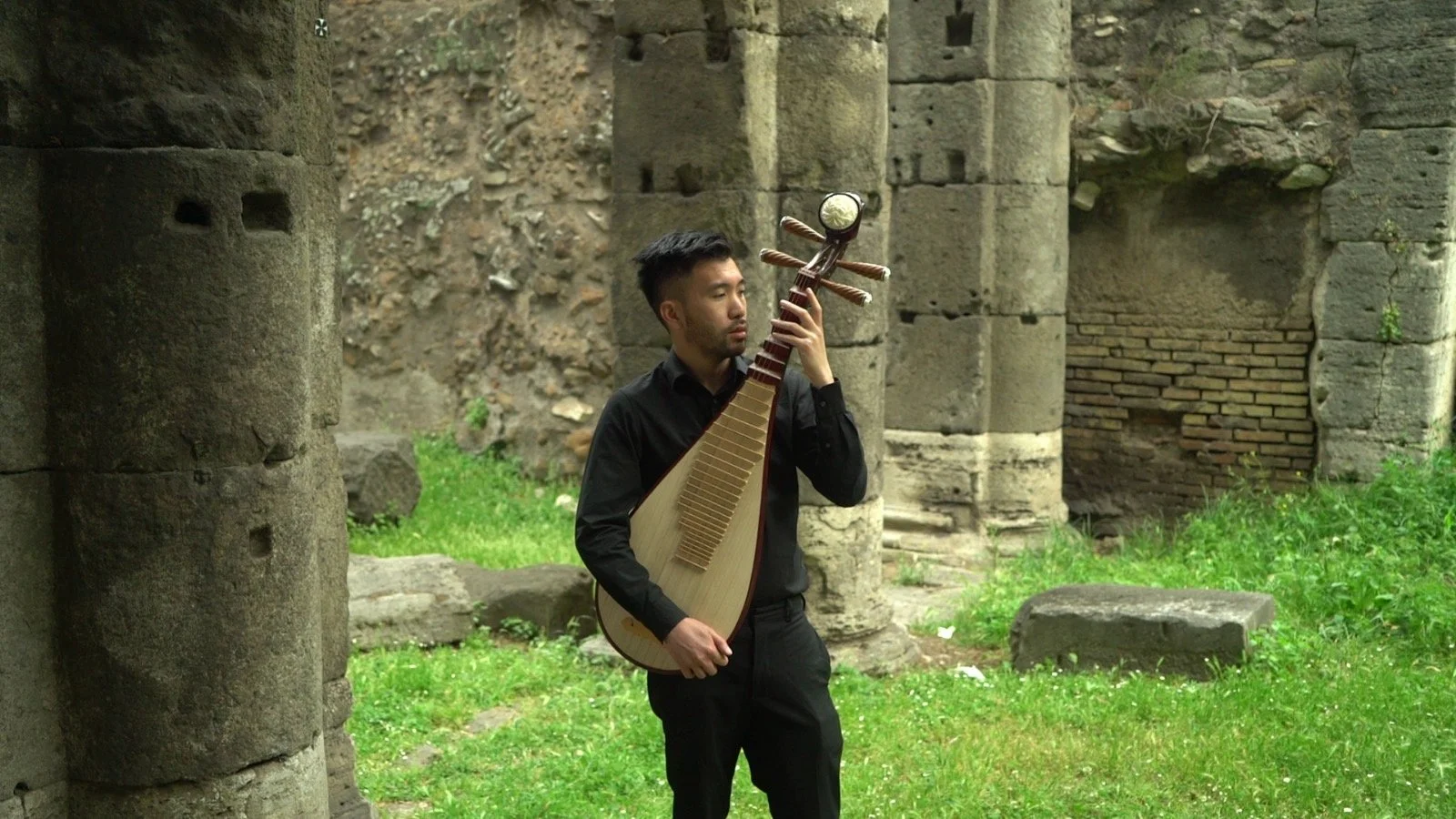
BG: The film is a way for us to get visual context for the pipa in a contemporary perspective. In the film, the pipa travels to places where you would find some members of the East Asian diaspora. This gives a sort of visual landscape to reflect what is happening musically in the ensemble, where I wanted to create a kind of hybridity where no instrumentalist feels like an other. But personally and artistically, I wanted to do this kind of research because it forced me to get to know these places really well.
LB: I want to go back to this concept of how identity needs to be renegotiated. How do you explore this idea in the piece - how it occurs in the context of a particular geography, and how that is represented sonically or visually?
BG: I mentioned this example of XiMenDing,, which is a kind of place and geography where, because of the people that pass through it, since it's such an economic center in an international setting, people need to be checking their assumptions about where people are coming from and their interests in the space. Another great example is Villa Gordani in Rome, which is a park with ancient Roman ruins. It’s on the east side of Rome, where there are a lot of migrant communities, so there are a lot of people from the Chinatown nearby, and working class people from the Filipino community a bit further east, that come to the park. So it’s a very immigrant-friendly and family-friendly place during the day. But then as soon as it gets dark, it becomes a cruising space for queer communities, including queer communities of color. And I was really interested in how, when you’re there at dusk or dawn, when we filmed, the function of the space changes.
LB: Could you tell us about the concept of post-diaspora, and what you found inspiring or germane about it?
BG: The term comes from a really influential article called “Against Diaspora” by Shu-mei Shih, a scholar of Asian American Studies at UCLA. The main thrust of her argument is that, in a globalized present and future, ethnicity, and our sense of self, shouldn’t be determined only on our ancestral homelands. Instead, as I said earlier, anyone should be able to be a local, wherever they’re from.
She thinks about this particularly in the case of Chinese-speaking communities. Rather than thinking of diaspora as a sort of nostalgia for ancestral homeland, even one someone had never lived in, she wanted to come up with something more forward-looking, which was the idea of the Sinosphere — the idea that anyone who speaks Chinese, no matter where they were born, could participate in this identity group. Personally, I think there are some problems with this formulation — one being that basing this solely on speaking Chinese promotes a hierarchy of Mandarin above other Chinese dialects, and there’s a long history of violence that comes with the spread of Mandarin and it being forced upon communities, as in Hong Kong and Guangzhou.
But what I took from it, and how it generated some ideas about the piece, was that it got me thinking about my personal identity and, more generally, identity for members of any diaspora, in a forward-looking way as opposed to a nostalgic one centered on loss. So, I wanted to write a piece that thought about the vibrancy of migration and engaged new questions about what it means to live in a globalized world.
LB: I’m so glad I had this conversation, because I feel like I’ve gained even more insight into the piece, and I’m excited that we’ll be able to share this context with our audiences. Thank you so much.
BG: This was really wonderful. Thank you so much for these questions. A lot of fun, as always.